


























How to Choose the Right Weight for Strength Exercises
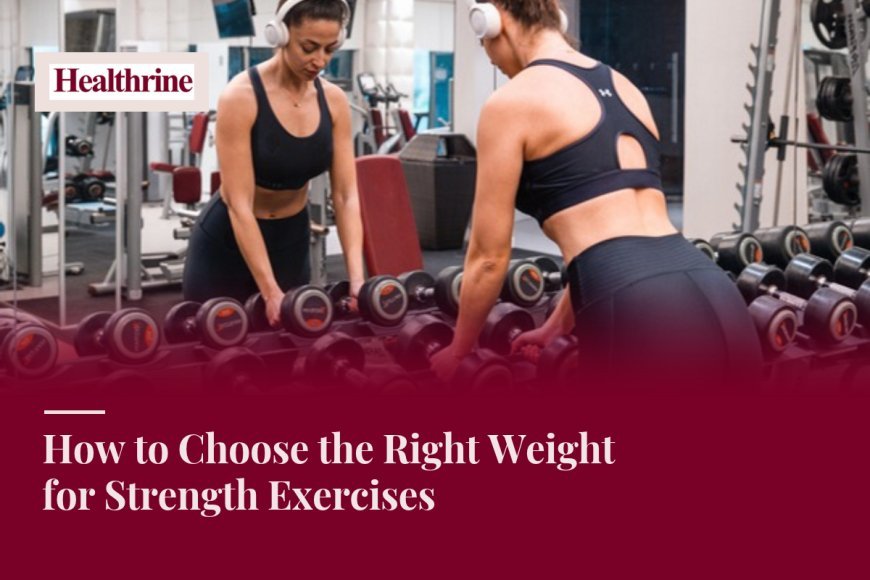
Picture the dumbbell rack at a busy community gym on a Monday night. Someone grabs the 30-pound pair because the person before them used it. Someone else picks up the 5-pound pair, does fifteen easy curls while scrolling a phone, and wonders why nothing seems to change. Both are guessing, and guessing is the most common way people choose a weight.
There is a calmer, more reliable approach. It doesn't require a coach, an app, or a spreadsheet. It asks you to pay attention to how a set feels, especially the last few repetitions, and to adjust from there. This guide walks through a simple way to find a starting weight for common strength exercises, how to tell whether it fits, and how to move up gradually without rushing.
What the Guidelines Actually Say
The CDC's physical activity guidance for adults, based on the Physical Activity Guidelines for Americans, suggests muscle-strengthening activities at least two days a week that work the major muscle groups: legs, hips, back, chest, abdomen, shoulders, and arms. It describes one set as about 8 to 12 repetitions and suggests doing each exercise to the point where it is hard to do another repetition without help. At least one set is the starting point, and the CDC notes that two or three sets can add more benefit.
That phrase, "hard to do another repetition without help," is the key to choosing a weight. It means the weight is not chosen by a number on the handle. It's chosen by how the final reps of a set feel for you, on that exercise, on that day.
For beginners, many trainers soften this a little. Rather than pushing every set until you truly can't do one more, a common approach is to stop when you feel you could manage only one or two more clean repetitions. You get the benefit of real effort while keeping your form tidy and leaving a little in reserve while you learn the movement.
The Two-Reps-Left Test
Here is a practical way to try it with any exercise, whether it's a goblet squat, a dumbbell row, or an overhead press.
- Pick a weight you're fairly sure is too light. This is your warm-up set.
- Do 10 repetitions with slow, controlled form. Breathe out on the effort and in on the return.
- At the end, ask yourself one question: how many more good-form reps could I do?
- If the answer is five or more, rest for a minute and try the next weight up.
- Keep going until you find a weight where the last two reps of a set of 10 feel challenging and you could do about one or two more with good form.
That weight is your working weight for now. Write it down. It might be 12 pounds for a shoulder press and 25 pounds for a goblet squat, and that gap is completely normal. Your legs and back are usually stronger than your shoulders and arms, so each exercise tends to have its own number.
If the very first set feels hard by rep six, the weight is too heavy for this rep range. Drop down. There's no prize for struggling through a set with a weight you can't control.
What Good Form Looks Like When It Starts to Slip
The two-reps-left test only works if you are honest about form. A weight is too heavy when the exercise quietly changes shape to make room for it. A few signs many people notice:
- Your back arches or rounds to help move the weight
- You swing or bounce instead of lifting and lowering smoothly
- Your knees cave inward on squats or lunges
- You hold your breath and strain for the last few reps
- The range of motion gets shorter with each rep
- You feel a sharp or pinching sensation rather than the steady, tiring effort of working muscles
If any of these show up before the last couple of reps, lighten the load. Fatigue in the working muscles is expected. Pain in joints is a signal to stop that exercise for the day. If something hurts during or after training, or if you have a heart condition, joint concerns, are pregnant, or are returning after an injury, it makes sense to check with a health care provider or a qualified trainer before you add weight.
A mirror or a quick phone video can help. Many people are surprised by what they see. A set that felt smooth may look a bit wobbly, and that's useful information, not a failure.
Light, Medium, and Heavy Days Are Not Required
Some beginners worry they need complicated plans with different weights for different days. You don't. For the first several weeks, one working weight per exercise is plenty. Repeat the same weight for two or three sessions and let the movement feel familiar.
What tends to happen next is pleasant. The set of 10 that felt challenging starts to feel more comfortable. You notice you could do three or four more reps at the end. That's the signal to progress.
There are a few common ways to move forward gradually:
- Add reps first. If your working weight is good for 10, aim for 11 or 12 at the same weight over the next sessions. When 12 clean reps feel manageable with a couple left over, it's time for the next step.
- Then add a little weight. Go up to the next dumbbell size, often 2.5 to 5 pounds for upper-body moves and 5 to 10 pounds for lower-body moves. Drop back to around 8 reps with the new weight and build up again.
- Add a set. If you've been doing one set, add a second. The CDC notes two or three sets can bring more benefit, and adding a set is a gentle way to do more without changing the weight.
Change one thing at a time. If you add reps, weight, and sets all in the same week, it's hard to tell which change made a session feel rough. A quick note on your phone with the date, weight, sets, and reps makes this easy to track, and some days will simply feel heavier than others after poor sleep or a long week. On those days, it's fine to drop back a little.
When Your Gym Doesn't Have the Weight You Need
Gaps between dumbbells can be awkward, especially at home where you might own only a few pairs. If 15 pounds feels too easy and 20 pounds feels too hard, you have options that don't involve buying anything:
- Slow the tempo. Take three seconds to lower the weight and one to lift it. The same weight feels noticeably harder.
- Add a pause at the hardest point, such as a one-second hold at the bottom of a squat.
- Do the exercise one side at a time. A single-arm row or a split squat with the lighter weight can feel like a big jump in effort.
- Use the heavier weight for fewer reps, around 6 to 8, and build up slowly.
Resistance bands follow the same idea. Choose a band where the last couple of reps of a set feel challenging with good form. If the band feels too easy, step farther from the anchor point or use a thicker band.
A Sample First Week
If you'd like a simple place to start, here's one way a beginner might use the two-reps-left test on two nonconsecutive days, such as Monday and Thursday:
- Goblet squat: find a weight for 10 reps with one or two left in reserve, 1 to 2 sets
- Dumbbell row, one arm at a time: same approach, 1 to 2 sets per side
- Dumbbell chest press on a bench or the floor: 1 to 2 sets
- Romanian deadlift with dumbbells, light and slow while you learn the hip hinge: 1 to 2 sets
- Overhead press, seated or standing: 1 to 2 sets
- A plank or dead bug for the core: 2 rounds of a comfortable hold
Warm up first with five minutes of easy walking, marching in place, or light cycling, plus a few practice reps of each movement with no weight. Rest about one to two minutes between sets.
The goal in week one is not to find your maximum. It's to find your starting point and learn what effort feels like. Once you know that, choosing the right weight stops being a guess. It becomes a small, steady conversation between you and the weights, one set at a time.
What's Your Reaction?
 Like
0
 Dislike
0
 Love
0
 Funny
0
 Angry
0
 Sad
0
 Wow
0