






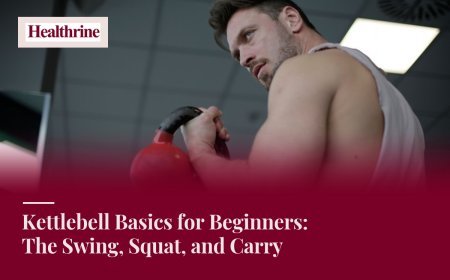














Kettlebell Basics for Beginners: The Swing, Squat, and Carry
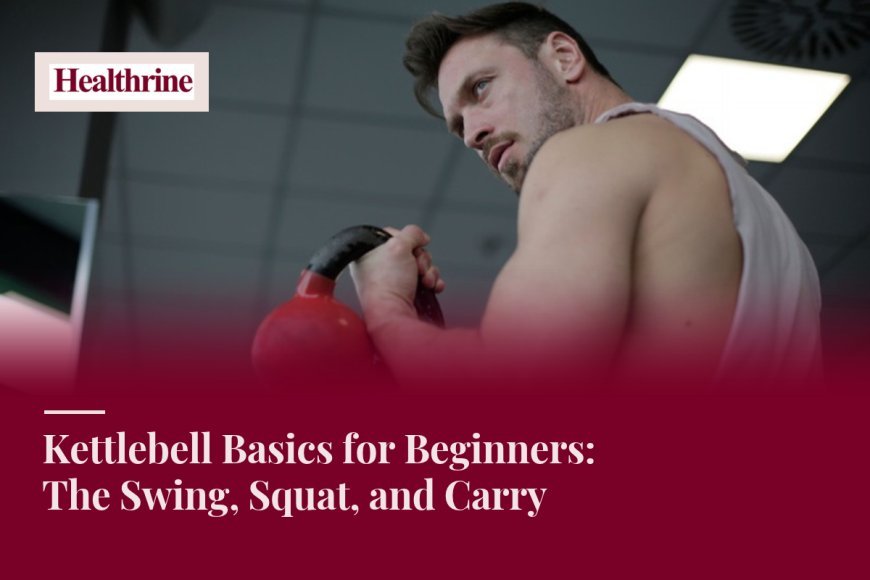
A kettlebell looks a little like a cannonball with a suitcase handle, and that odd shape is exactly what makes it useful. Because the weight hangs below the handle, it moves differently from a dumbbell, which is why one well-chosen bell can cover a surprising amount of ground in a small living room or garage.
If you already have a bodyweight routine, a kettlebell can be a natural next step. If you are starting from scratch, it is still a friendly tool, as long as you begin with a few basic moves and take your time with them. This guide focuses on three: the goblet squat, the carry, and the swing. Together they cover lower body, grip, posture, and the hip hinge, which is the movement pattern behind lifting things off the floor in everyday life.
A quick note before you start: the swing in particular is a skill. Reading about it is a good start, but many beginners find that one session with a qualified coach, or a beginner kettlebell class at a local gym, YMCA, or community center, saves weeks of guesswork. If you have any injury, joint concern, or health condition, or you are new to exercise, check in with your doctor or a physical therapist before adding weights.
Choosing your first kettlebell and setting up your space
Kettlebells in the U.S. are sold in pounds and in kilograms, and the jumps between sizes can be large. Common beginner sizes run from about 8 to 12 kilograms (roughly 18 to 26 pounds) for many women and 12 to 16 kilograms (roughly 26 to 35 pounds) for many men, but those are starting points, not rules. Your own strength, history, and comfort matter more than any chart.
A useful test is the goblet squat. Hold the bell by the horns, the sides of the handle, close to your chest. If you can lower into a comfortable squat and stand back up eight to ten times with steady form, and the last two reps feel challenging but clean, that size is probably a reasonable place to begin. If your back rounds, your heels lift, or you feel the need to rush, try a lighter one.
Look for a bell with a smooth handle that fits both hands comfortably, a flat base so it sits steady on the floor, and a finish that is not slippery. Cast iron and competition-style steel bells both work. Adjustable kettlebells save space, but check that the plates lock securely before you swing one.
Kettlebell work needs more room than it might seem, especially the swing. Clear a space roughly the length of your body in front of you and a couple of feet to each side. Move the coffee table, check for low light fixtures, and keep pets and small children out of the area while you train.
Train on a firm, flat surface. A thin rubber mat or a section of carpet works. Thick yoga mats can feel unstable underfoot. Wear flat shoes or go barefoot so your feet can grip the floor, and keep a towel nearby so your hands stay dry. A sweaty grip is one of the most common reasons a bell slips.
Finally, give yourself permission to put the bell down. Setting it on the floor between sets, under control, is always better than pushing through a rep that feels wrong.
The goblet squat
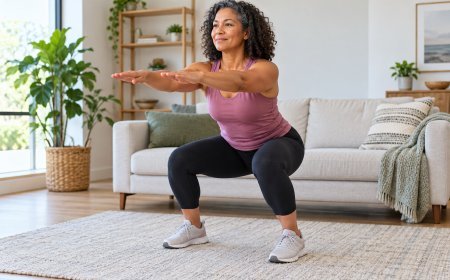
The goblet squat is often the friendliest place to start, because holding the weight in front of your chest naturally encourages an upright torso.
- Stand with your feet a little wider than hip width, toes turned out slightly.
- Hold the kettlebell by the horns, close to your chest, elbows pointing down.
- Take a breath, brace your midsection as if you are about to be gently nudged, and sit your hips down and back between your heels.
- Lower as far as you can while keeping your chest up and your heels on the floor. Your elbows may brush the inside of your knees.
- Press through your whole foot to stand back up, and breathe out near the top.
Form cues many coaches use: knees track in the same direction as your toes, weight stays spread across the whole foot, and the bell stays close to your body. If depth is limited, squat to a sturdy chair or bench and stand back up. That is still a real squat.
The carry
Carries sound almost too simple to count as exercise. You pick up a weight and walk. But they ask a lot of your grip, your shoulders, and the muscles that keep your trunk upright, and they are about as close to real life as training gets.
Start with the suitcase carry. Hinge at the hips to pick up the bell in one hand, stand tall, and walk slowly for about 30 to 40 steps. Keep your shoulders level and resist leaning away from the weight. Set it down with the same careful hinge, switch hands, and walk back.
Once that feels steady, you can try the front-rack carry, holding the bell at chest height with the handle in your palm and the ball resting on your forearm. Many people find this position awkward at first, so keep the weight light and the walks short.
The swing
The two-handed swing is the signature kettlebell move, and it is worth learning patiently. It is a hip movement, not a squat and not an arm raise. Your hips drive the bell and your arms mostly guide it.
- Set the bell on the floor about a foot in front of you. Stand with feet about shoulder width apart.
- Hinge at the hips, with a soft bend in the knees and a flat back, and grab the handle with both hands.
- Tip the bell back toward you and hike it between your legs, like a football snap, keeping your forearms close to your inner thighs.
- Stand up briskly by squeezing your glutes and driving your hips forward. The bell floats up to around chest height, arms relaxed.
- Let it fall back down, and hinge again as your forearms meet your thighs. Keep the bell high between your legs, not low near your knees.
- To finish, let the bell swing back once more and guide it to the floor in front of you.
Before you ever swing, many beginners practice the hinge with no weight at all, pushing their hips back toward a wall a few inches behind them. Then they practice deadlifting the bell from the floor with the same hinge. Only once that feels natural do they add the swing. If you feel the move mostly in your lower back or shoulders, stop, lighten the load, and revisit the hinge. This is exactly the moment a coach or class can help most.
A simple starter routine
Two or three short sessions a week, with a rest day between them, is plenty for the first month. Each session might look like this:
- Warm up for about five minutes: march in place, roll your shoulders, and do ten bodyweight squats and ten unweighted hip hinges.
- Goblet squat: 3 sets of 8 reps, resting about a minute between sets.
- Kettlebell deadlift, as practice for the swing: 3 sets of 8 reps.
- Suitcase carry: 3 walks of about 30 steps per hand.
- After two or three weeks of smooth deadlifts, add two-handed swings: 3 to 5 sets of 10, resting as long as you need.
- Finish with a few minutes of easy walking and gentle stretching.
Stop each set while you could still do two or three more good reps. Clean, unhurried repetitions are the goal at this stage, not exhaustion.
Progressing slowly and sensibly
Kettlebell training rewards patience. Before you move up a size, try adding a rep or two per set, an extra set, or a few more steps on your carries. Many people stay with their first bell for a couple of months, and that is completely normal.
When a size starts to feel easy across every move, with steady form all the way through, it may be time to consider the next one up. You might find you use a heavier bell for squats and carries and keep a lighter one for swings while you refine the technique.
Pay attention to how your body responds over the following day or two. Ordinary muscle tiredness is common when you start something new, but sharp or lingering pain is a reason to stop and check in with a professional.
One kettlebell, three moves, and a few square feet of floor are enough to build a routine you can stick with through the winter. Start light, learn the hinge, and let the weight go up only when your form is ready for it.
What's Your Reaction?
 Like
0
 Dislike
0
 Love
0
 Funny
0
 Angry
0
 Sad
0
 Wow
0