








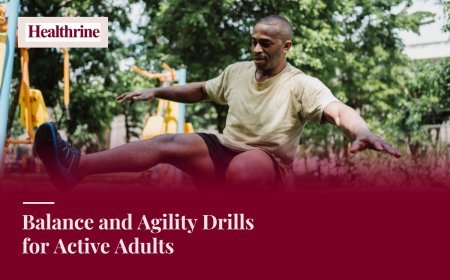



















Balance and Agility Drills for Active Adults

Balance is easy to take for granted until a patch of ice, an uneven trail, or a sudden change of direction on the court puts it to the test. For active adults who already walk, run, lift, or play sports, balance and agility drills can be a fun way to add variety to training and to practice moving with more control.
This guide is for people who are already comfortable on their feet and want to go beyond supported exercises. If you are just starting out or would like something steadier, our guide to simple balance exercises you can practice beside a chair is a better first step. The drills here are unsupported and dynamic, meaning they involve movement, reaching, and changing direction.
Before you begin, a quick safety note. Practice on a flat, non-slip surface with plenty of clear space around you, wear supportive shoes, and stop if you feel dizzy, unsteady, or any pain. If you have a health condition, a recent injury, or concerns about your balance, check with a health professional before starting new exercises.
Why balance and agility belong in an active routine
Balance is the ability to keep your body steady, whether you are standing still or moving. Agility is the ability to change direction and speed quickly while staying in control. Both draw on strength, coordination, and body awareness, and both can be practiced like any other skill.
CDC physical activity guidance for adults recommends at least 150 minutes of moderate-intensity aerobic activity each week, plus muscle-strengthening activities on two or more days. For older adults, CDC also includes balance activities in its recommendations. Balance and agility drills can slot neatly alongside these, as part of a warm-up or as a short session of their own.
Many active adults also find these drills make their main sport or workout feel smoother. Trail runners often like the extra confidence on uneven ground, and racquet sports players often enjoy sharper footwork. Even if you simply walk a lot, practicing balance can make moving through icy or crowded winter streets feel more comfortable.
Warm up first
Spend five minutes warming up before balance and agility work. March or jog gently in place, then do some leg swings forward and back and side to side, some walking lunges, and a few ankle circles in each direction. Warm muscles and joints tend to respond better, and the warm-up gets your attention focused on how you are moving.
Keep each drill short and controlled, especially the first few times you try it. Quality matters more than speed or the number of repetitions. If a drill feels wobbly in a way that makes you uneasy, step back to an easier version.
Single-leg and reaching drills
Single-leg reach: Stand on your right foot with a soft knee. Slowly reach your left foot forward, tapping the floor lightly, then return to the center. Repeat the tap to the side and behind you. Do eight to ten rounds, then switch legs. For more challenge, reach farther or reach your hand toward the floor at the same time.
Single-leg deadlift reach: Stand on one leg and hinge at the hips, reaching your hands toward the floor while your other leg extends behind you. Keep your back long and your standing knee slightly bent. Return to standing with control. Start with a small range of motion and increase it as you feel steady. Aim for six to eight on each side.
Clock taps: Imagine you are standing in the middle of a clock face on one foot. Tap the other foot to twelve, three, six, and nine o'clock, returning to the center each time. Move slowly and keep your hips level. This is a good drill for building body awareness in multiple directions.
Footwork, hops, and direction changes
Lateral shuffles: Stand with your feet hip-width apart and knees slightly bent. Shuffle sideways for four or five steps, then shuffle back. Keep your chest up and your feet from crossing. As you get comfortable, increase speed or add a quick touch to the floor at each end.
Carioca: Moving sideways, step your trailing foot behind your lead foot, then step the lead foot out, then bring the trailing foot across the front. Keep the movement light and rhythmic. Start slowly to learn the pattern, then build up to a brisker pace over a short distance, such as the length of a room or a hallway.
Ladder-style footwork: You do not need an agility ladder. Use chalk on a driveway, masking tape on the floor, or simply imagine a ladder. Try quick feet in and out of each square, two feet in each box moving forward, or side steps through the boxes. Keep steps small and quick, and look ahead rather than down at your feet where possible.
Lateral hops: Stand on both feet and hop gently side to side over a line on the floor. Land softly with knees slightly bent. Once that feels comfortable, try hopping forward and back. Advanced exercisers can try single-leg hops, but only if two-footed hops feel steady and controlled.
Star drill: Place a marker in the center and four markers a few steps away in a cross pattern. Starting from the center, move quickly to one marker, touch it, and return to the center, then move to the next. Mix forward runs, side shuffles, and backpedals. This drill builds quick direction changes with control.
Hop-and-hold: Hop forward on one foot and hold the landing for two to three seconds, keeping the knee soft and the hips level. Then hop again. This combines power and stability. Start with small hops and focus on a quiet, controlled landing before adding distance.
Putting it together
A simple session might look like this: a five-minute warm-up, two rounds of single-leg reaches and clock taps, two rounds of lateral shuffles and carioca, and one or two rounds of lateral hops or the star drill. Rest as needed between drills. The whole session can take fifteen to twenty minutes.
You can also sprinkle drills into other workouts. Add a few single-leg reaches to a strength session, a round of carioca to a running warm-up, or ladder-style footwork before a tennis match. Two or three short sessions a week is a manageable place to start.
Progress gradually. Once a drill feels easy and controlled, make it slightly harder by adding speed, increasing distance, closing your eyes for a few seconds during a static hold if you feel very steady and are near a wall, or performing it on a slightly softer surface like grass. Change only one thing at a time.
Listen to your body
Balance can vary from day to day. Fatigue, poor sleep, or simply a busy mind can make drills feel harder. On those days, choose easier versions or focus on slower, steadier movements. That still counts as practice.
Pay attention to your surroundings, too. Indoors, move furniture and rugs out of the way before starting. Outdoors in winter, skip agility work on wet leaves, frost, or ice, and save it for a dry path or an indoor space. Choosing the right setting is part of training smart.
Balance and agility drills can be a playful, challenging addition to an active lifestyle. With a little regular practice, many people find they move with more confidence and control, whether they are on the trail, the court, or a slippery winter sidewalk.
What's Your Reaction?
 Like
0
 Dislike
0
 Love
0
 Funny
0
 Angry
0
 Sad
0
 Wow
0