





















Bodyweight Strength for Beginners: Push, Pull, Squat, and Hinge Explained
Strength training can sound like it belongs in a gym, surrounded by racks, benches, and people who seem to know exactly what they are doing. Your living room tells a different story. With a chair, a wall, a sturdy table edge, and your own body, you can learn the four movement patterns that sit underneath most everyday strength: pushing, pulling, squatting, and hinging.
Learn those four patterns slowly and well, and you have something more useful than a random list of exercises. You have a way to stand up from the floor, carry shopping, move furniture with a friend, and get through a day of lifting, reaching, and climbing stairs with a body that feels practiced rather than surprised.
Push: Press the World Away
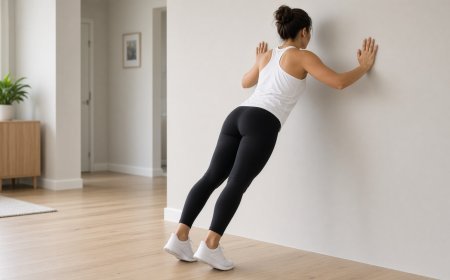
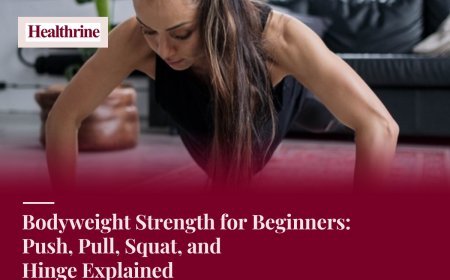
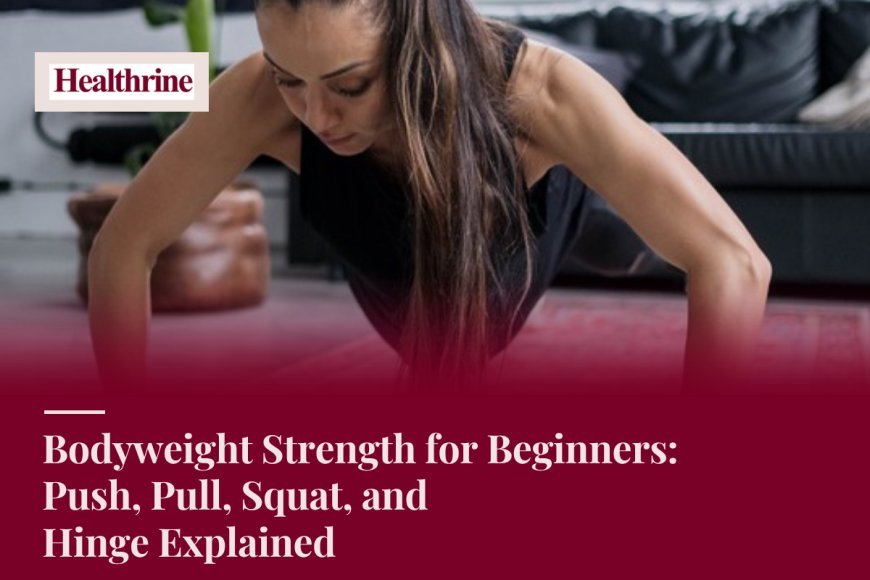
Pushing is what you do when you press a heavy door, get up from the floor, or push yourself away from a kitchen counter. The classic bodyweight version is the push-up, and the beginner version is proudly adjustable. Start with your hands on a wall, a counter, or the arm of a sturdy sofa, your body in one straight line, and lower yourself with control before pressing back.
The American Council on Exercise describes the push pattern with hands under the shoulders and a straight line from head to heels, avoiding sagging hips. Keep that picture in mind at every level. When wall presses feel steady for comfortable repetitions, move to a counter, then to a chair seat or low step, then toward the floor, perhaps from your knees before your toes. Each step down makes the same pattern a little more demanding.
Elbows should travel at a comfortable angle rather than flaring straight out to the sides. Move slowly enough that you could pause halfway. If your lower back starts to dip or your shoulders creep toward your ears, the level is too hard for today. Easier and tidy beats harder and messy, every time.
Pull: The Pattern Home Workouts Forget
Pulling balances pushing. It is the motion of drawing a heavy bag toward you, starting a mower, or rowing. It is also the pattern most home routines skip, because gravity is less cooperative. A sturdy table can help. Lie underneath it, hold the edge with both hands, keep your body straight, and pull your chest toward the table edge before lowering slowly. Only use furniture that is genuinely solid, does not move, and lets you keep your feet planted safely.
A simpler starting point is a backpack row. Put a few books in a backpack, stand with soft knees, hinge forward slightly as described below, and draw the bag toward your ribs, then lower it with control. One side at a time works too, with the free hand resting on a chair for support. A towel looped securely can create similar options, but check any setup twice and never trust a door or fixture that was not built to hold your weight.
Pulling should feel like work across the back of the shoulders and between the shoulder blades, paired with hands and arms doing their share. Keep the movement smooth and stop well before the shape falls apart. Because pulling is easy to undertrain at home, even one modest pulling choice in each session keeps the four-pattern set honest.
Squat: Sit Down and Stand Up, on Purpose
You already squat every day. A chair is simply a squat with a landing pad. Stand in front of a sturdy chair, feet about hip to shoulder width apart, and sit back until you lightly touch the seat, then stand by pressing the floor away. The American Council on Exercise's bodyweight squat guidance uses feet slightly wider than hips, chest up, and knees tracking in the same direction as the toes. Those cues fit the chair version, too.
Use your arms as helpers at first: reach them forward as you sit back, or hold the edge of a table for balance. Touch the chair lightly rather than collapsing onto it. As confidence grows, hover just above the seat for a breath before standing, or remove the chair while keeping the same patient shape.
Depth is not a contest. A comfortable range that keeps your heels grounded, knees tracking happily, and back in a natural position is the right range for you today. If getting low is not comfortable yet, raise the target with a higher chair, a firm cushion, or a stack of books on the seat. Strength built in a range you control will carry over. Forced depth usually teaches your body to avoid the exercise.
Hinge: Let Your Hips Do the Lifting
The hinge is the pattern behind picking up a laundry basket, a grocery bag, or a small child without turning the job into a back negotiation. Stand tall, soften your knees slightly, and push your hips backward as if closing a car door behind you, keeping your back in its natural shape and letting your torso tip forward as one piece. Then press your hips forward to stand.
Practice first without any load, perhaps standing a short distance from a wall and reaching your hips back to touch it. A light household object held close to your body comes next. The hinge should be felt mainly in the backs of the thighs and the hips, with the load kept close. If you feel yourself rounding forward and reaching with your arms, reset, move the object closer, and make the hip movement smaller.
Go slowly in both directions. The way down teaches as much as the way up. Once a plain hinge feels familiar, a single-leg version with a hand on a chair for balance can be explored, but there is no deadline. Two legs, good shape, and steady repetition cover a great deal of ground.
Putting the Four Together
The CDC summarizes the Physical Activity Guidelines for Americans as muscle-strengthening activity on two or more days a week that works the major muscle groups. A beginner bodyweight session can honor that guidance simply: one push, one pull, one squat, and one hinge, each for one or two comfortable rounds, with rest whenever you need it.
Move at a pace where you can speak in short sentences and keep your shape. Finish feeling like you could have done a little more. That restraint is not wasted potential. It is what makes the next session welcome instead of daunting, and it leaves room to progress by choosing a slightly harder level, adding a repetition, or slowing the lowering phase.
Choose levels you can repeat with good shape twice in the same week. Write down which level you used for each pattern. That small note removes guesswork next time and turns progress into something visible: counter push-ups became chair push-ups, chair squats began to hover, the backpack gained a book.
Stop any exercise that causes sharp or worrying pain, dizziness, or a feeling that something is not right, and talk with a doctor or qualified professional if you are returning after an injury, managing a condition, or unsure what is appropriate for you. Ordinary effort and mild next-day stiffness are familiar parts of learning. Pain is information to respect, not a toll to pay.
Four patterns, a chair, a wall, a sturdy edge, and a backpack. Start where your shape stays tidy, repeat the same simple session until it feels almost easy, then change one level at a time. That is how bodyweight strength stops being a performance and becomes part of how you move through your house, your week, and your life.
What's Your Reaction?
 Like
0
 Dislike
0
 Love
0
 Funny
0
 Angry
0
 Sad
0
 Wow
0