




























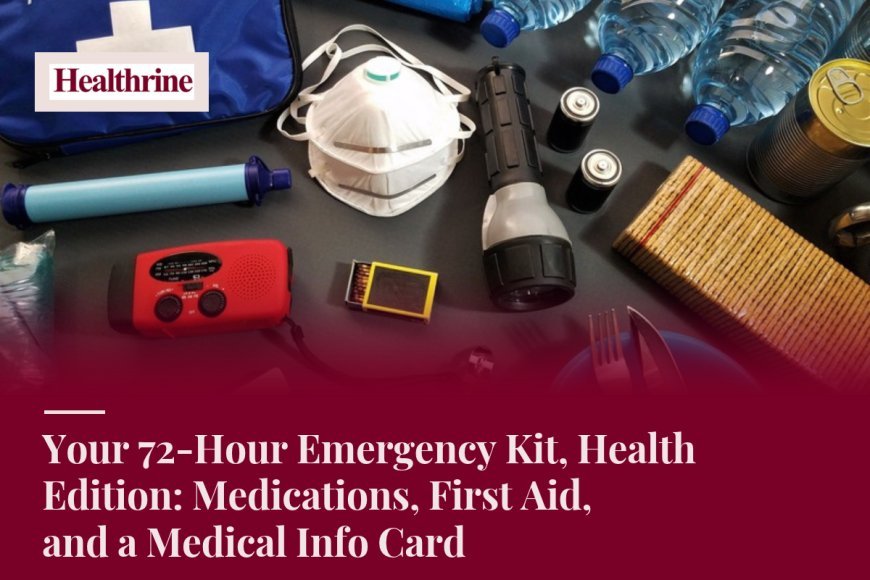
Your 72-Hour Emergency Kit, Health Edition: Medications, First Aid, and a Medical Info Card
Picture a Tuesday evening in late fall. The wind picks up, the lights flicker twice, and then the house goes quiet. Someone finds a flashlight in the junk drawer. Someone else checks their phone: 40 minutes of battery left. And then a small, practical question surfaces: how many days of pills are actually left in that bottle on the kitchen counter?
Most short disruptions pass without drama. Still, that moment is a good reminder of why so many emergency agencies suggest planning for about three days on your own. The UK government's new Be Ready campaign, published October 22, 2026, asks households to be ready for 3 days of disruption to services like power and water. Canada's GetPrepared guidance has long suggested a kit that lets a household manage for at least 72 hours, and Ready.gov in the US talks about supplies for several days. The framing in all of them is routine readiness, the same spirit as keeping a spare tire in the car.
Food, water and flashlights get most of the attention. This guide focuses on the health side: the medicines, records and small personal items that are easy to forget and hard to replace in a hurry.
Start With a Simple Medicine Inventory
Before buying anything, take ten minutes and look at what your household actually uses every day. Prescriptions, over-the-counter pain relievers, allergy tablets, inhalers, eye drops, vitamins, test strips, hearing aid batteries: write them all down, person by person.
Then check two things for each item: how much is on hand, and when the next refill is due. Many people discover they routinely run their prescriptions down to the last day or two before picking up the next fill. That works fine in normal weeks, but it leaves no cushion if the pharmacy is closed, the roads are icy or the power is out.
The FDA's emergency guidance suggests knowing how much medicine you have on hand and, if you expect pharmacy access to be disrupted, asking about early refills. Ready.gov goes a step further and suggests aiming for about a week of daily medicines and supplies where possible, and the American Red Cross kit list also mentions a 7-day supply. If that isn't possible for you, the advice is the same: keep as much as you reasonably can and talk to your pharmacist or doctor about what else to do.
Talk to Your Pharmacist About a Small Buffer
This is the step people skip, and it is often the most useful. A short conversation at the pharmacy counter can answer questions you may not know to ask:
- Can my refill be timed a few days earlier so I am never down to the last dose?
- Does my plan allow a 90-day supply, or mail-order delivery, for medicines I take long term?
- Are there state emergency refill rules where I live? The FDA notes that these laws exist and suggests learning about them.
- How should this particular medicine be stored if it gets warm or cold?
Your pharmacist can also tell you which items are fine to keep in a kit and which are better left in their usual place and grabbed on the way out. Pharmacists field these questions all the time, and many people find the conversation takes less than five minutes.
Storing Medicines So They Stay Usable
Most tablets and capsules do best in a cool, dry place, which is why the bathroom cabinet, with its steamy showers, is often not ideal. Keep medicines in their original labeled containers so the name, strength and directions travel with them.
The FDA also suggests placing medicine bottles or packages in watertight containers, such as plastic containers with lids, and storing them where floodwater is unlikely to reach. A zip-top bag inside a small plastic tub is an inexpensive way to do this.
Medicines that need refrigeration take a little more planning. The FDA lists insulin and certain liquid antibiotics as examples, and it suggests having a plan to keep them cold during an outage: a cooler and ice or frozen gel packs, following each product's labeled storage instructions. For insulin specifically, the FDA notes that manufacturer vials and cartridges, opened or unopened, can generally be left unrefrigerated between 59 and 86 degrees Fahrenheit for up to 28 days and continue to work. It also says to keep it as cool as possible, never let it freeze, keep it out of direct sun and heat, and not to use any that has frozen.
If something that should stay cold has been warm for a while, the FDA's advice is to check the storage instructions or contact a pharmacist, health care provider or the manufacturer. Every product is different, so this is a perfect question to settle with your pharmacist before you ever need the answer.
Make a One-Page Medical Info Card
In a stressful moment, memory is unreliable. A single written page can speak for you when you can't, or when a neighbor, relative or responder is helping. The FDA suggests keeping an up-to-date list of medicines with the name and strength of each, what it is for, how much you take and when, along with any conditions, medical supply needs and allergies. It also suggests keeping a copy of your prescriptions with your emergency supplies.
A simple card for each person might include:
- Full name, date of birth and an emergency contact
- Each medicine with its strength, dose and timing
- Allergies, including medicine and food allergies
- Any medical devices used and where their instructions are kept
- Primary doctor, preferred pharmacy and their phone numbers
- Insurance information, or a copy of the card
Print it, fold it into the kit in a waterproof bag, and keep a photo on your phone as a backup. Ready.gov also suggests that anyone with a communication disability note the best way to communicate with them. Set a calendar reminder to update the card whenever a prescription changes.
A Lean First-Aid and Hygiene Pouch
If you already keep a home first-aid kit, you don't need to build a second one from scratch. Healthrine's guide to building a home first-aid kit that actually gets used covers that in detail. For a 72-hour plan, a small travel-size pouch that can be grabbed quickly is usually enough: adhesive bandages, gauze, tape, gloves, a thermometer, tweezers, and any over-the-counter basics your household already relies on.
Ready.gov's list adds soap, hand sanitizer and disinfecting wipes, moist towelettes, garbage bags and plastic ties for personal sanitation, and feminine supplies and personal hygiene items. A toothbrush, toothpaste and a small pack of tissues per person round it out without taking much room.
The Small Items People Forget
The items that cause the most frustration in an outage are often small and personal. Ready.gov and the American Red Cross both mention a few that are easy to overlook:
- Spare prescription glasses, or contact lenses with solution
- Hearing aids and extra batteries
- A phone charger plus a charged backup battery pack
- Extra batteries for any device someone relies on day to day
- Copies of insurance cards and key documents in a waterproof bag
The UK Be Ready checklist adds a charged power bank to keep phones or compatible medical devices running. If anyone in your home uses powered medical equipment, it may be worth asking the supplier or your care team what their backup plan is during an outage.
None of this needs to happen in one weekend or cost very much. The UK checklist suggests building readiness gradually, picking up an extra item or two during regular shopping, and setting a reminder every six months to check expiry dates and swap anything out. That is a rhythm many households find easy to keep, perhaps on the same weekends the clocks change.
A good first step this week: write the medicine list, make one call to the pharmacy about refill timing, and put a printed copy of the info card where you'd grab it on the way out the door. Then, the next time the lights flicker, the question about the pill bottle on the counter already has an answer.
This article is general information. For questions about your own medicines, storage or refills, please check with your pharmacist or doctor.
What's Your Reaction?
 Like
0
 Dislike
0
 Love
0
 Funny
0
 Angry
0
 Sad
0
 Wow
0