





























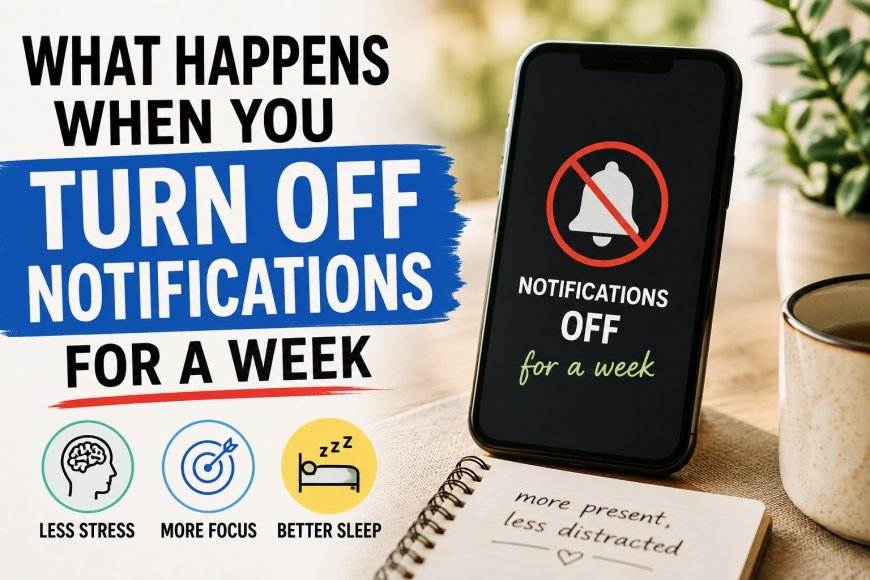
What Happens When You Turn Off Notifications for a Week
our phone buzzes. You look.
An email arrives. You look again.
Someone likes your photo. A news app sends a breaking alert. Your favorite store announces a sale. A group chat suddenly comes alive. Before you realize it, you've picked up your phone dozens of times throughout the day—sometimes without even remembering why.
Notifications were created to make our digital lives more convenient, but they can also make it surprisingly difficult to leave our phones alone. Every vibration, sound, and banner competes for attention, even when the information isn't particularly important.
So what would happen if you turned off most of those notifications for an entire week?
You don't have to abandon your smartphone, delete your social media accounts, or disappear from the internet. Simply deciding when you want to check your apps instead of allowing them to constantly call for your attention can make your relationship with technology feel very different.
Here's what you might notice.
The First Day May Feel Surprisingly Strange
You might expect turning off notifications to immediately feel peaceful.
Instead, the first thing you notice may be how often you instinctively reach for your phone.
Without a notification prompting you, you may still unlock the screen to check email, social media, messages, or news simply out of habit.
That can be revealing.
We often assume notifications are the only reason we check our phones, but repeated checking can become an automatic behavior of its own.
During the first day or two, you may even wonder whether you've missed something because your phone has been unusually quiet.
That feeling usually says more about how accustomed you've become to constant alerts than about anything actually going wrong.
Your Phone Starts Feeling Less Urgent
Notifications create a sense of immediacy.
A banner appearing on your screen seems to say, "Look at this now."
But most notifications aren't emergencies.
That social media like will still be there in an hour. The shopping promotion can wait. You probably don't need to know immediately that a streaming service added a new show.
Once those interruptions disappear, your phone can begin feeling less like something demanding your attention and more like what it was supposed to be: a tool you use when you need it.
That small shift can feel surprisingly liberating.
You May Check Social Media Less Often
Social media apps have a powerful advantage when notifications are enabled: they can remind you to come back.
Someone commented. Someone posted. You have a new follower. Here's something you might have missed.
Remove those prompts, and you may discover that you weren't actually choosing to open certain apps as often as you thought.
Without a notification providing the initial trigger, hours can pass before you remember to check.
You haven't necessarily lost interest. You've simply removed one of the cues that repeatedly brought the app back into your attention.
Your Focus May Feel Less Fragmented
Imagine you're reading, working, cooking dinner, or having a conversation when your phone lights up.
Even if you don't respond, you've noticed it.
Part of your attention has shifted away from whatever you were doing.
Multiply that by dozens of alerts throughout the day, and it's easy to understand why modern life can sometimes feel mentally scattered.
Turning off unnecessary notifications doesn't eliminate every distraction, but it removes one source of constant interruption.
You may find it easier to finish what you're doing before moving on to something else.
Conversations Can Feel Different
There's something subtly disruptive about talking with someone while a phone repeatedly lights up on the table.
Even when nobody picks it up, the notification is competing with the conversation.
With fewer alerts, meals and conversations can become less interrupted.
You may also notice how frequently other people's phones interrupt them once yours stops doing the same thing.
That doesn't mean phones need to be banned from every social situation. It simply demonstrates how easily digital interruptions have become part of everyday interactions.
You Might Discover How Many Alerts You Never Needed
This may be one of the biggest surprises of the experiment.
Once you review your notification settings, you may wonder why some apps were allowed to interrupt you in the first place.
Does a shopping app really need permission to alert you whenever there's a sale?
Do you need immediate updates from every news organization?
Does a game need to remind you that you haven't played recently?
Many notifications are designed primarily to bring you back into an app, not because the information requires your immediate attention.
After a week without them, some alerts may seem far less important than they did before.
You May Stop Reaching for Your Phone as Soon as You Wake Up
Notifications can make the phone particularly tempting in the morning.
You wake up and immediately see a collection of alerts accumulated overnight. Before you've even gotten out of bed, you're reading messages, checking social media, scanning headlines, and responding to email.
Turning off unnecessary notifications removes some of that invitation.
Your phone is still there, of course. You can still check it whenever you want.
But opening it becomes a choice rather than a response to a screen filled with things demanding attention.
That can make it easier to establish a calmer morning routine.
Your Evenings May Feel Quieter Too
The same principle applies at night.
A notification arriving while you're reading, watching television, spending time with family, or preparing for bed can pull you back into your digital world.
One alert can easily become twenty minutes of scrolling.
Reducing unnecessary evening notifications can make it easier to create a boundary between the connected part of your day and the quieter period before sleep.
You don't have to become completely unreachable. The goal is deciding which people and situations genuinely deserve immediate access to your attention.
You Probably Won't Miss as Much as You Expect
One of the biggest concerns people have about disabling notifications is missing something important.
After a week, you may discover that very little actually changed.
Messages were still waiting when you opened the app. Emails didn't disappear. Social media continued without you. News stories were still available later.
You simply received the information on your schedule instead of the app's schedule.
Of course, some notifications genuinely matter. Calls from family members, security alerts, calendar reminders, banking alerts, school notifications, or messages required for work may deserve immediate attention.
The experiment isn't about turning off everything.
It's about becoming more selective.
You Become More Intentional About Checking Your Phone
Perhaps the most useful change is recognizing the difference between choosing to check your phone and being prompted to check it.
Those behaviors may look identical from the outside, but they feel very different.
When notifications are constantly arriving, your phone determines when interactions begin.
Without them, you decide.
You might check email after breakfast, messages during lunch, and social media when you actually have time to enjoy it.
Technology hasn't disappeared from your life. You've simply changed who initiates the interaction.
How to Try a One-Week Notification Reset
You don't need to silence every alert on your phone.
Start by turning off notifications from apps that rarely deliver genuinely urgent information. Social media, games, shopping apps, entertainment services, food delivery promotions, and general news alerts can be good places to start.
Keep the notifications that matter to your safety, family, work, finances, appointments, or other important responsibilities.
Then try living with those settings for seven days.
Instead of checking every app whenever you think about it, you can also choose a few natural times during the day to catch up.
The goal isn't to prove that you can live without your phone. It's to discover which notifications actually improve your life and which ones simply interrupt it.
What Should You Turn Back On After the Week?
At the end of seven days, don't automatically restore your old settings.
Ask yourself which notifications you genuinely missed.
Maybe you want text messages and calendar reminders back but realize you were happier without social media alerts. Perhaps banking notifications are useful, while shopping promotions aren't. Maybe you still want breaking news but only from one trusted source instead of five different apps.
Your ideal setup will be different from someone else's.
The important part is that each notification earns its place rather than being enabled simply because an app requested permission.
You Don't Need a Full Digital Detox
Digital wellness is sometimes presented as an all-or-nothing choice.
Delete social media. Turn off your phone. Spend an entire weekend offline.
Those approaches may work for some people, but they're not realistic or necessary for everyone.
Technology is deeply integrated into modern life. We use phones for work, communication, banking, navigation, entertainment, photography, transportation, and staying connected with people we care about.
A healthier relationship with technology doesn't necessarily mean using less of everything.
Sometimes it simply means allowing fewer things to interrupt you.
Final Thoughts
Turning off notifications for a week probably won't transform your life overnight.
You'll still have emails to answer, messages to read, responsibilities to manage, and plenty of opportunities to become distracted.
But you may notice something surprisingly valuable: silence.
Your phone stops constantly announcing itself. Social media becomes something you visit rather than something that summons you. Conversations experience fewer interruptions. Work can happen for longer stretches. Your mornings and evenings may feel a little less crowded.
And perhaps most importantly, you begin deciding when your phone deserves your attention.
After seven days, you may turn some notifications back on.
You might also realize you don't miss many of them at all.
What's Your Reaction?
 Like
0
Like
0
 Dislike
0
Dislike
0
 Love
0
Love
0
 Funny
0
Funny
0
 Angry
0
Angry
0
 Sad
0
Sad
0
 Wow
0
Wow
0