




























Milestone Birthdays at 40, 50, and 60: Reframing What Comes Next
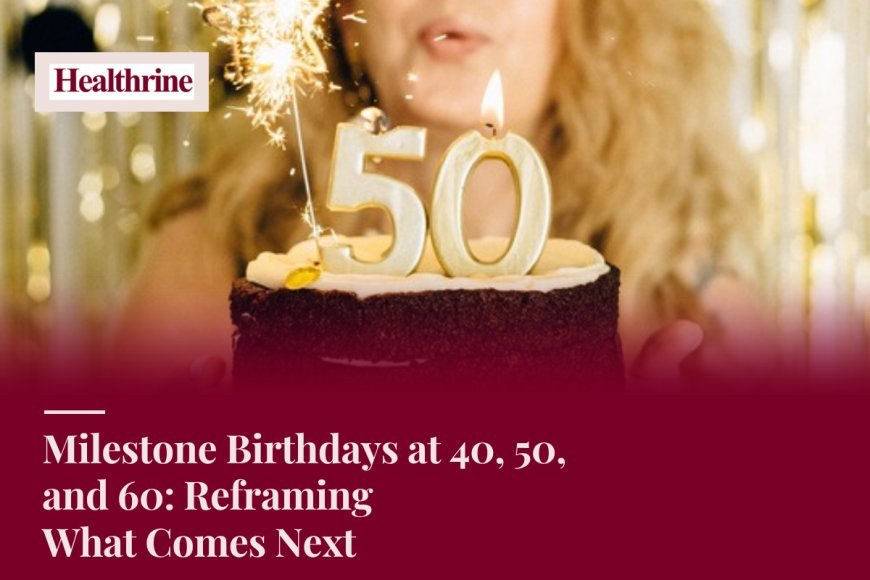
A round number is coming for you, if it has not recently been. Forty, fifty, sixty: birthdays that arrive with bigger cards, jokes about candles, and a particular question asked at kitchen tables in the small hours. Is this what I thought it would look like? The question sounds like an audit. Handled gently, it can become something much more useful, a chance to notice what a decade actually contained and to choose the next one with a little more intention.
This is not about denying age, chasing youth, or setting heroic goals under a balloon arch. It is about reframing, in the ordinary sense of moving a picture slightly so you can see it properly. The same life, looked at with a wider frame, often contains more continuity, competence, and unfinished curiosity than the milestone moment first suggests, and fewer verdicts than the birthday-week mood implies.
Different decades ask different questions, of course. Forty often interrogates choices. Fifty often interrogates time. Sixty often interrogates what comes next, in work, in family, in the shape of a week. Underneath all three sits the same human habit worth examining: measuring a whole life against an imaginary schedule written by a much younger person with very partial information.
Retire the imaginary schedule
Most of us are still being graded, in our own heads, against a timetable drafted in our twenties. It specified, with outrageous confidence, the right ages for work, love, money, children or no children, houses, achievements, and a settled feeling that has never once arrived on schedule for anyone. A milestone birthday is a good occasion to thank that young planner for their enthusiasm and formally retire their spreadsheet.
Compare, if you must compare, against your own previous decade rather than against other people's edited highlights. What do you know now that you genuinely did not know at thirty, forty, or fifty? What have you stopped doing that once consumed you? What difficulty did you get through that would have floored your younger self? That ledger, written honestly, is usually longer and kinder than the one kept against strangers on the internet.
Some grief is legitimate and should not be reframed away. Not every hope fits into a life, time does close certain doors, and a milestone can sharpen that knowledge. Making room for a straightforward acknowledgment, this did not happen, and I am sad about it, is part of an honest birthday. Reframing is not pretending. It is refusing to let one closed door narrate the entire house.
Try writing two short lists, privately, over a coffee. On one side, what this decade gave you, including things you never ordered: skills, people, knowledge of yourself, second chances, unexpected pleasures. On the other, what you are setting down: obligations, pretenses, feuds, ambitions that turned out to belong to someone else. Most people find the second list produces the stronger feeling, and it usually feels like relief.
Let each decade ask its own question
At forty, the useful question is often what you want more of and less of, now that you have data. You have watched yourself work, love, fail, recover, and spend ordinary Tuesdays for twenty adult years. That evidence outranks prediction. Many people at forty do not need a new personality. They need permission to stop auditioning: fewer commitments taken to look impressive, more taken because Tuesdays are better with them in the calendar.
At fifty, time often becomes the honest subject. Not in a gloomy way, but in the practical sense that seasons are visibly finite and therefore more valuable. The reframing available here is from quantity to placement. Where does your attention actually go in a week, and does that match what you say matters? Small reallocations, an hour protected here, a no said kindly there, change the felt shape of a year more than dramatic reinventions do.
At sixty, the question frequently widens beyond work, sometimes because work itself is changing shape. What is my usefulness, my pleasure, my company, my curiosity for, in this next stretch? People answer it with mentoring, study, volunteering, grandchildren, travel, making things, local involvement, or a deliberate and hard-earned idleness after decades of being needed. There is no correct portfolio. There is only the difference between drifting into a shape and choosing one.
Notice that none of these questions has a deadline of your birthday. A milestone is a useful prompt, not an exam date. You are allowed to spend the year after a big birthday considering it, trying small experiments, and changing your mind. Lives are mostly changed by accumulation anyway: the class joined in March matters more than the resolution announced in the birthday week to general applause.
Mark it in a way that suits who you are now
Celebrations copied from other people's milestones can miss the person entirely. If a large party would delight you, have one, and enjoy the rare sight of your different worlds in one room. If it would exhaust you, smaller and more specific is not lesser: a walk with three old friends, a meal where phones stay away, a solo trip you have postponed for years, a day spent doing the thing you loved at sixteen, badly and happily.
Consider marking the decade with evidence rather than only with an event. Letters from friends, a photograph taken in a place that matters, a list of one hundred things the decade contained, a playlist built year by year. Objects and records outlast the mood of a party, and on a flat day two years later they will argue, persuasively and in detail, that your life has been full of people and moments.
Include younger and older people where you can. Friends a decade ahead are living proof that life continues to contain beginnings, jokes, romances, projects, and strong opinions about restaurants. Friends a decade behind repay your experience with energy and remind you which of your current worries age tends to solve. A table with a spread of ages is one of the great pleasures of the middle decades, and milestones are a fine excuse to assemble one.
If gifts are happening, it is permissible to guide them. Ask for experiences together, contributions to a planned trip, books chosen personally, or nothing but presence and a card with actual sentences in it. People are usually relieved to be told what would genuinely please you. A milestone is wasted on polite pretending, in presents as in everything else. State preferences warmly and receive what comes with grace.
Choose one thread for the next decade
Grand plans made under birthday emotion tend to evaporate, so choose one thread instead: a direction you can pull gently for years. Learning a language slowly. Becoming the person in your family who writes things down. Getting strong and staying mobile in ways you enjoy. Making your home the place people gather. One thread, loosely held, gives a decade a sense of direction without turning it into a performance contract.
Attach the thread to the calendar in its smallest form. A weekly class, a monthly meeting, a standing walk, a savings pot with a name. Decades are built out of recurring Tuesdays far more than out of dramatic beginnings, and a small recurring thing survives busy seasons that kill ambitious projects. If it lapses, restart it without ceremony. Restarting is the skill every long endeavor actually runs on.
Tell one or two people what you have chosen, not to create pressure but to create company and memory. They will ask about it at the next birthday, kindly, and you will be surprised how much there is to say about ten years of a modest thread faithfully pulled. That conversation, at the next round number, is the real gift of choosing one now. Happy birthday. The frame was always bigger than the photograph.
What's Your Reaction?
 Like
0
 Dislike
0
 Love
0
 Funny
0
 Angry
0
 Sad
0
 Wow
0