



























Cozy Without Couch-Bound: Keeping Energy Up on Cold Evenings

Cozy has a public relations problem in winter. It arrives dressed as a blanket, a glowing screen, and a horizontal evening from which nobody rises until bedtime, slightly stiff and oddly more tired than when they sat down. Yet the instinct underneath it is sound. Cold evenings ask for warmth, softness, and a slower pace. The trick is keeping the comfort while refusing the collapse.
This is about energy on cold evenings in the ordinary, lifestyle sense: feeling awake enough to enjoy your evening, rather than spending it in a fog and then going to bed annoyed at the lost hours. It assumes nothing about your health. If tiredness ever feels persistent or out of proportion, that is a conversation for a provider who knows you. What follows is about lamps, movement snacks, warm drinks, and plans that fit on a sofa-adjacent scale.
Begin by noticing what your current evening actually looks like between dinner and bed. For many households it is one long sit, broken by trips to the kitchen, conducted under either harsh ceiling light or the blue glow of a television, in a room that gets stuffier as the heating works. Each of those details is adjustable, and small adjustments compound surprisingly well across a whole evening.
Light the room for awake, then for winding down
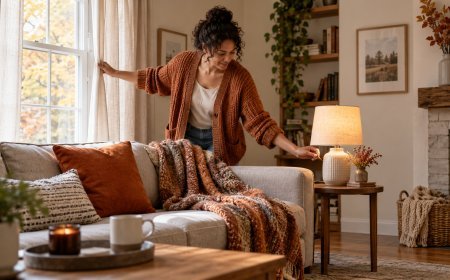
Evening light has two jobs, and trouble starts when one light tries to do both at the same hour. Early in the evening, while you are cooking, tidying, helping with homework, or doing anything upright, you want the room properly lit so your eyes are not straining and the space feels alive. Table and floor lamps spread around the room do this more kindly than a single overhead light, and they make faces look like faces.
Later, in the last stretch before bed, dimming those same lamps or switching some off tells the room, and everyone in it, that the day is closing. We have written before about softer evening lighting as a way to make a house feel ready for rest. Use that idea for the final hour. The point here is sequence: bright enough to live by first, softer to land by later, instead of semi-gloom from six o'clock onward.
Screens complicate this because they bring their own light and their own momentum. You do not need a rule against them to have a good evening. It helps to give viewing a beginning and an end: a particular program, watched in a chair that is not your bed, with a lamp on, rather than an endless scroll of episodes in the dark that finishes when you wake up on the sofa at midnight with a stiff neck.
If the evening feels stale, change the light before changing anything else. Open a window for five minutes, even in January, to clear warm, used air. Turn on the lamp in the neglected corner. Light a candle safely on a stable surface if you enjoy one, away from curtains and never left unattended. Small sensory changes wake a room up faster than resolutions do.
Move a little, often, without a workout
The body reads a four-hour sit as instruction to power down, whatever your intentions were. You do not need exercise in the athletic sense to counter that. You need interruptions: standing to make tea, walking to another room rather than asking someone to fetch things, putting laundry away in three trips instead of one, stretching your calves and shoulders while the kettle boils.
Tie movement to things that already punctuate the evening. When an episode ends, get up before the next begins. During a phone call, walk around your home if the call allows it. After dinner, take ten unhurried minutes to reset the kitchen, put music on, and call it the evening's turning point rather than a chore wedged inside your rest. Dishes done early buy a surprisingly peaceful later evening.
The CDC advises adults to aim for about one hundred and fifty minutes of moderate-intensity activity across the week, plus muscle-strengthening activity on two or more days, and notes that activity can be spread out and broken into smaller amounts. An evening walk contributes to that total, but so does dancing badly in the kitchen, an active game with children, or a short bodyweight routine on the rug if that is something you already enjoy and can do comfortably.
Warmth helps movement feel inviting rather than virtuous. Keep the room comfortable rather than tropical, because overheated rooms make most people drowsy. Dress in layers you can adjust, keep slippers or warm socks by your chair, and let getting up feel physically pleasant. A cold floor is a persuasive argument for never leaving a blanket. Remove the argument, not the blanket.
Keep cozy, add a small plan
Comfort itself is not the enemy, and an evening that is all self-improvement is its own kind of bleak. Keep the blanket, the good chair, the warm drink, the familiar program. Just give the evening one or two small anchors that ask a little of you: a chapter read rather than scrolled past, a hand of cards, a crossword shared badly, twenty minutes of a hobby that leaves something visible behind, like rows of knitting or a page of drawing.
Hands are a useful clue. Evenings feel longer and richer when hands are doing something beyond holding a phone: mending, sorting photographs, playing an instrument imperfectly, preparing tomorrow's lunch, writing a real card to someone. Occupied hands make sitting feel chosen rather than defaulted into, and time passes in a way that feels spent rather than leaked.
Company, in person or by phone, changes the physics of an evening too. Invite low-effort company: a neighbor for tea, a friend for a walk with torches and warm hats, a relative on a video call while you both cook. Cold weather shrinks social life by default, so a little deliberate scheduling matters. Keep it short, warm, and easy to leave, and people will say yes more often than you expect.
Plan tomorrow briefly, then close the notebook. Writing down the first task of the morning, laying out clothes, or packing a bag takes five minutes and removes a low background hum of unfinished business that can make an evening feel restless. Then stop. The evening is not an antechamber to tomorrow. It deserves its own pleasures, taken awake.
An evening shape worth trying
Try, for a few nights, a loose shape rather than a schedule. After dinner, move for ten minutes while you reset the kitchen and put music on. Then take the bright-lamp part of the evening for anything upright or sociable. Then claim your chair, blanket, and warm drink without apology, with one small hands-busy pleasure alongside the screen. In the last hour, dim the lamps, let the pace drop, and do the quiet things.
Notice the difference, if any, in your own ordinary terms. Did the evening feel longer, in the good way? Was getting up and going to bed easier than rising from a three-hour slump? Did you enjoy the program you watched because you were actually watching it? Your answers, not a metric, decide whether the shape suits your household, your work hours, and your winter.
Some evenings will still collapse into the sofa, because people are tired, weather is weather, and life is not a brochure. Let those be what they are, warmly and without a post-mortem. The aim across a winter is a slight shift in the average evening, from couch-bound by default to cozy by choice, with enough light, movement, and small pleasures in it that you reach bedtime feeling you had an evening, rather than lost one.
What's Your Reaction?
 Like
0
 Dislike
0
 Love
0
 Funny
0
 Angry
0
 Sad
0
 Wow
0