





























The Phone Parking Spot: A Simple Way to Create More Screen-Free Time at Home
Phones are useful precisely because they follow us everywhere. That convenience also makes it easy to check a message during dinner, scroll while talking, or carry work notifications into the evening. A phone parking spot is a designated place where household members can leave devices during selected parts of the day.
The idea is not to treat technology as the enemy. It is to create a little distance between an impulse and the screen, making room for conversation, rest, chores, hobbies, and quiet without demanding an unrealistic digital detox.
Why a physical location can change a habit
Many phone checks begin automatically. The device is already in a hand or pocket, so opening an app takes almost no effort. Placing it across the room adds a pause. That small pause can be enough to notice whether the check is necessary or simply habitual.
Choose a spot that fits your home
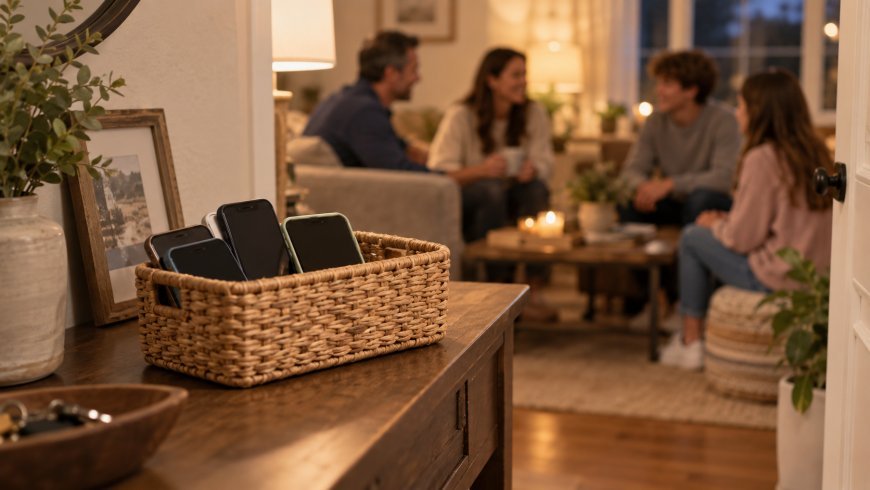
A basket on an entry table, charging station in the kitchen, or shelf near the living room can work. The location should be visible and convenient but not in the center of social activity. Avoid placing it beside the television remote if that area already attracts constant attention.
If devices charge there, use safe equipment, keep cords tidy, and avoid covering phones with fabric. The goal is a calm routine, not a decorative setup that creates clutter.
Start with one screen-free window
Do not begin by parking every phone for an entire evening. Choose a repeatable period such as dinner, the first thirty minutes after everyone arrives home, or the final hour before bed. A short clear rule is easier to understand and less likely to feel punitive.
Decide what counts as an exception
Some people need to remain reachable for work, caregiving, school, or emergencies. Agree on exceptions before the routine begins. Calls from selected contacts can remain audible, or one household phone can stay available. An exception should solve a real need without turning every notification into an emergency.
Make the rule apply fairly
Children notice when adults demand device-free time while keeping their own phones nearby. A shared parking spot works best when the expectation is visible and mutual. The exact rule can vary by age and responsibility, but adults should model the attention they are asking others to give.
Replace the screen with something specific
Removing a habit creates an empty space. Decide what belongs there: eating together, a short walk, music, a game, reading, stretching, or preparing for tomorrow. The replacement does not need to be productive. It simply needs to be easier to begin than retrieving the phone.
Expect some discomfort at first
You may reach for a phone that is no longer in your pocket or wonder whether you missed something. That does not mean the experiment is failing. It shows how strongly the movement has become linked to boredom, uncertainty, or transitions. Notice the urge without criticizing yourself, then return attention to the room.
Use visual cues rather than repeated reminders
A small sign, charging tray, or consistent basket can cue the behavior without one person acting as the phone police. A routine is more peaceful when the environment carries part of the reminder. If someone forgets, a neutral phrase such as “phones are parked during dinner” is usually enough.
Review what actually changes
After one week, ask simple questions. Did meals feel calmer? Did conversations last longer? Was bedtime smoother? Did anyone feel anxious about availability? The purpose is not to prove that screens are bad. It is to learn which boundaries improve the household and which need adjustment.
Keep it flexible for guests and unusual days
A rigid rule can create more tension than it solves. Guests may need directions, parents may be waiting for a call, and travel days work differently. Keep the core intention—being more present—while allowing sensible exceptions. Return to the normal routine at the next opportunity.
A simple seven-day experiment
Pick one location and one thirty-minute window. Tell everyone why you are trying it, agree on emergency access, and prepare one easy offline activity. Repeat for seven days. At the end, keep the parts that helped, move the basket if necessary, and lengthen the window only if it feels realistic.
The bottom line
A phone parking spot makes screen-free time easier by changing the environment instead of relying entirely on willpower. Start small, make the expectation fair, protect genuine availability needs, and focus on what you want more of—not only what you are trying to reduce.
What's Your Reaction?
 Like
0
Like
0
 Dislike
0
Dislike
0
 Love
0
Love
0
 Funny
0
Funny
0
 Angry
0
Angry
0
 Sad
0
Sad
0
 Wow
0
Wow
0